
Live Facial Recognition Technology
What is Facial Recognition Technology?
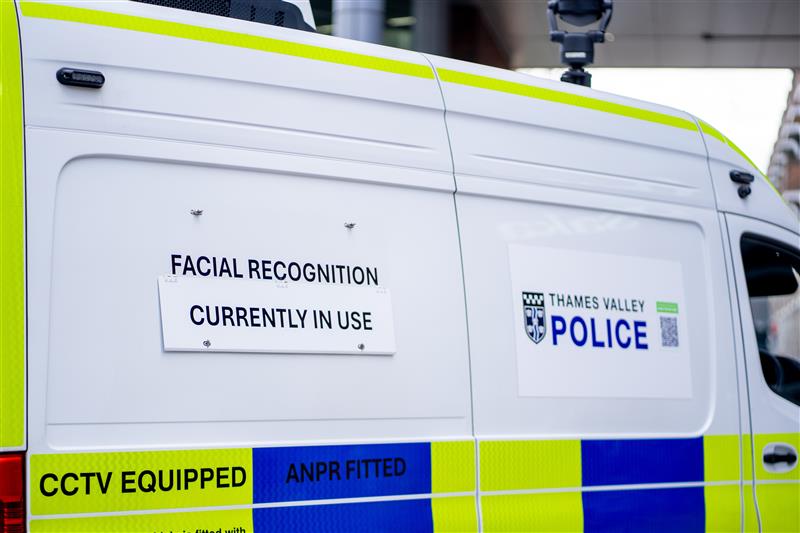
Thames Valley Police uses facial recognition technology to prevent and detect crime and help protect the vulnerable.
Facial Recognition is a technology capable of comparing a digital image taken of a human face, against a database of facial images.
Live Facial Recognition is used as a precision crime-fighting tactic to locate people who are of interest to the police. It helps us reduce violence and the risk of harm, prevent and detect crime, apprehend and prosecute offenders, protect the public, secure the administration of justice and maintain public confidence.
How does Facial Recognition Technology work?
It analyses key facial features and generates a mathematical representation of these features called a biometric template. It then compares this template against the biometric templates of known faces in a database, generating possible matches.
Thames Valley Police uses Facial Recognition Technology in two ways:
- Live Facial Recognition (LFR) – this compares a live camera feed of faces against a predetermined watch list to find a possible match that generates an alert.
- Retrospective Facial Recognition (RFR) – this is a post-event tactic which compares still images of faces of unknown subjects (for example, CCTV from a crime scene) against the Police National Database in order to identify the unknown person.
Nationally, Facial Recognition Technology is also used by policing in the following case, however this is not currently employed within Thames Valley Police:
- Operator Initiated Facial Recognition (OIFR) - A photograph of a person’s face is taken on a mobile phone by, for example, a police officer. This is then compared against a predetermined watch list to assist an officer in identifying the person.
Whenever we use Facial Recognition Technology, we recognise there is an ongoing need to balance privacy and protection concerns, in addition to considering its legal and ethical implications.
Future deployments
| Date | Location |
| 22 October 2026 | Broad Street, Reading |
| Date | Location |
| 23 October 2026 | Northbrook Street, Newbury |
Previous deployments
Deployment data will be posted online as soon as possible; this should be no longer than 7 days.
October - December 2026
| Date | Location |
|---|---|
| Wednesday 7 October | High Street, Slough |
July - September 2026
| Date | Location |
|---|---|
| Friday 18 September | High Street, Slough |
| Thursday 17 September | Farnham Road, Slough |
| Wednesday 16 September | Market Square, Witney |
| Friday 4 September | Eden Centre, Wycombe |
| Sunday 30 August | Thames Promenade, Reading |
| Saturday 29 August | Caversham Road, Reading |
| Friday 28 August | Reading Festival |
| Thursday 27 August | Reading Festival |
| Tuesday 25 August | Market Square, Aylesbury |
| Monday 24 August | Broad Street, Reading |
| Tuesday 18 August | The Lexicon, Bracknell |
| Friday 7 August | High Street, Slough |
| Thursday 30 July | Cornmarket Street, Oxford |
| Thursday 23 July | Slough, High Street |
April - June 2026
| Date | Location |
|---|---|
| Tuesday 30 June | Amersham, Sycamore Road |
| Monday 29 June | Windsor, Peascod Street |
| Friday 12 June | Eden Centre, Wycombe |
| Friday 29 May | Sheep Street, Bicester |
| Wednesday 20 May | Market Square, Aylesbury |
| Tuesday 19 May | Cornmarket Street, Oxford |
| Monday 18 May | High Street, Slough |
| Monday 11 May | Oxford Road, Reading |
| Tuesday 21 April | Slough High Street |
| Monday 20 April | Chesham High Street |
| Monday 13 April | Market Square, Aylesbury |
January - March 2026
| Date | Location |
|---|---|
| Friday 20 March | Cornmarket Street, Oxford |
| Thursday 5 March | The Lexicon, Bracknell |
| Tuesday 3 March | Eden Centre, Wycombe |
| Friday 13 February | Slough High Street |
| Thursday 15 January | Reading Town Centre |
| Wednesday 14 January | Oxford City Centre |
| Tuesday 13 January | Wycombe Town Centre |
| Tuesday 13 January | Midsummer Place, Milton Keynes |
| Date | Location |
|---|---|
| Monday 22 December | Cornmarket Street, Oxford |
Live Facial Recognition documents
The PDFs on this page may not be suitable for users of assistive technology. We are in the process of updating them, but please email us to request an accessible version. See our accessibility statement.
Frequently asked questions
All LFR deployments use a CCTV feed to capture facial images before they are input into the LFR system for the purpose of matching. CCTV footage created for this purpose is recorded and kept for up to 31 days except in some very rare instances where it needs to be retained for evidence. This is in line with most other public CCTV systems.
If a captured face is not on a watchlist (i.e. the system does not match the face with one held on the database) we will not store this photograph or facial template (biometric data). They are immediately and automatically deleted after being captured.
Where a match is made, we will delete the photograph and the facial profile (biometric data) relating to it as soon as possible, after it has been used. This is usually during or at the conclusion of the LFR operation, but in all cases it is no longer than 31 days after the conclusion of the LFR operation.
Each watch list is created specifically for a single deployment of the technology, and will contain photographs and details of people who are wanted by the police for committing a crime or breaching conditions such as court orders, or wanted by the court or prisons. In some exceptional circumstances, watch lists may include photographs and details of persons who are missing and believed to be at risk of serious harm. Unless you are on the watch list, you cannot be matched. South Wales Police have led in the deployment of this technology, and in their deployments there has not been a single wrongful arrest because of their use of facial recognition.
The use of live facial recognition technology by Thames Valley Police is designed to be lawful, responsible, proportionate, and fair. It aims to keep the public safe, identifying offenders and protecting the vulnerable. Thames Valley Police aims to be as transparent as possible in our use of the technology in order to demonstrate effectiveness, proportionality and compliance with legislation and guidelines when deploying live facial recognition technology. We will always publish the dates and locations of a deployment several days in advance, except in very exceptional circumstances, and will always publish the results of those deployments.
Only persons who are of specific interest to the police will be on an authorised watch list, and nobody is able to opt out of this.
If you wish to physically avoid the technology, you may choose to do so, and you will not be stopped or obstructed. Avoiding the technology will not give a reason, on its own, for officers to have any interaction with you. We will always publish the dates and locations of a deployment several days in advance, except in very exceptional circumstances.
When the technology finds a possible match, an alert is generated. Any alerts are verified by an operator prior to an intervention by officers on the ground. The system will only seek to match those individuals placed on the watch list. Each watch list is unique to that event where the technology is being deployed.
No. The percentage can vary and is impacted by several factors including the scope of the watch list and how many people pass through the zone of recognition for the camera. Both of these vary considerably in respect of each unique operational deployment.
Thames Valley Police will do everything reasonably possible to inform the public where and when we intend to use Facial Recognition technology, for example:
- Online before it is used (including the results after LFR is used),
- Information leaflets,
- Posters and signs,
- Police officers who will be available at all deployments to explain how LFR works and why we are using it.
Historically, there have been some issues identified in relation to potential gender and ethnicity bias in respect of some types of Facial Recognition Technology. As the technology has developed over time this bias has reduced considerably.
The National Physical Laboratory has tested both the algorithm used by TVP for Live Facial Recognition (NEC Neoface) and the Home Office’s Police National Database (PND) algorithm used by TVP for Retrospective Facial Recognition (Cognitec FaceVACS DBScan ID v5.5).
Reports have been produced which give impartial, scientifically underpinned and evidence-based analysis of the performance of the algorithms, and the key findings show that:
- Live Facial Recognition: At the higher thresholds used by TVP, false positives are zero, and no demographic bias is detected. Read the full report:
Facial Recognition Technology in Law Enforcement Equitability Study Final Report, - Retrospective Facial Recognition (PND): At the settings used by TVP, if a correct match is on the database, the system will find it in 99% of searches. However, in a limited set of circumstances the algorithm is also more likely to incorrectly include some demographic groups (Black, Asian, female and younger people) in its search results. Read the full report:
Facial Recognition Technologies: Accuracy and Equitability Evaluation of Cognitec FACEVACS-DBSCAN ID V5.5
In order to mitigate against the risks presented by 'false-positive' results in its retrospective facial recognition searches, Thames Valley Police has implemented a number of measures around its use of the technology, in line with national guidance. Importantly, every facial match is reviewed by a human to ensure the match is accurate in their professional judgement, and no result is ever used as evidence – it is simply an intelligence indicator that the same person appears to feature in both images.
The use of Live Facial Recognition (LFR) and Retrospective Facial Recognition (RFR) by TVP have been subject to an Equality Impact Assessment (EIA). Read the LFR EIA. The RFR EIA is due to be published shortly.
If you have complaints, questions or comments about Thames Valley Police's use of Live Facial Recognition, please contact us at [email protected]